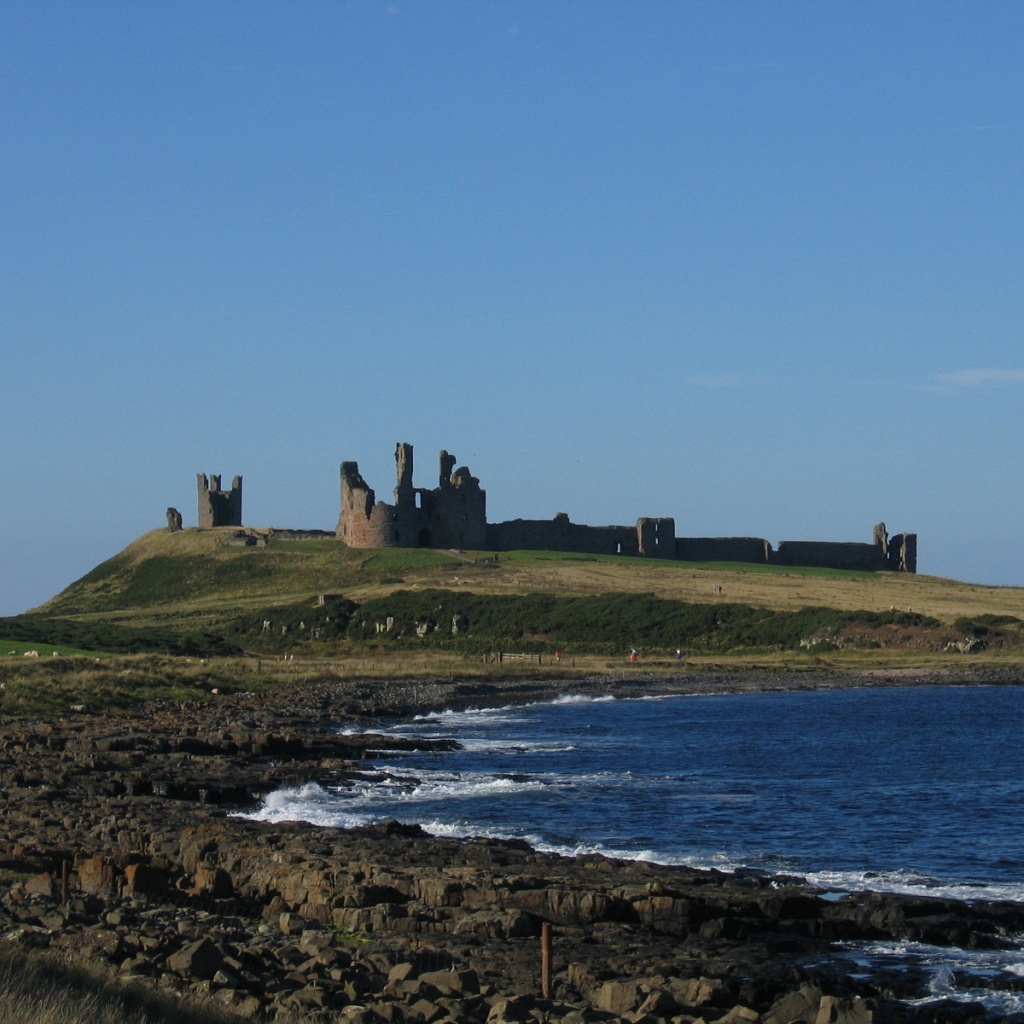
Warkworth Castle
One of England's Finest Castles
High over the river Coquet and the little town of the same name, Warkworth Castle proudly raises its remaining towers against the sky. While much of the castle is ruined, the huge cross-shaped keep still stands almost intact and the image it presents is awesome!
Warkworth is probably my favourite of all the castles I've visited so far, and part of this has to be due to its position.
Pevsner, the great chronicler of architectural marvels in England, advised to approach the castle from the north for the best views and I really cannot argue. Drive down from Alnwick towards the coast and the castle appears to be floating in mid-air right ahead of you.
Records of Warkworth reach back into the eighth century, but they don't mention fortifications. The first castle was most likely a wooden structure, built in the 12th century by Henry, son of King David I of Scotland, who held the title Earl of Northumberland while this part of the north was under Scottish rule.
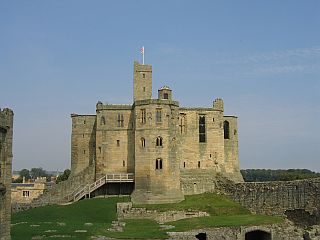 The cross-shaped keep of Warkworth Castle
 © essentially-england.com
Borderlands changed hands frequently and in 1158 the English king Henry II gave Warkworth to Roger FitzRichard, who most likely began to rebuild it in stone. His son Robert continued to improve and add to the buildings.
Ever at the forefront of disputes between the kings of England and Scotland, Warkworth Castle played host to King Edward I ("The Hammer of the Scots") in 1292 when the English king was asked to adjudicate the rival claims to the Scottish throne of John Balliol and Robert Bruce.
The king's decision was not to the Scots' liking and the following Anglo-Scottish wars saw the castle garrisoned and held by the English king's men.
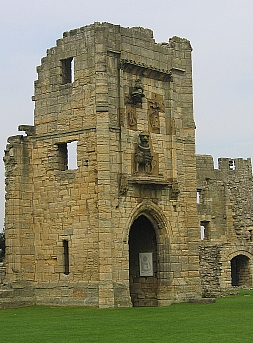 Warkworth Castle tower with Percy Lion
 © essentially-england.com
Warkworth castle saw much building work after Edward III granted it to Henry de Percy II in 1332. The elevated cross-shaped keep, a fine example from a time when castles were both fortresses and homes, dates from this time.
Still roofed and almost complete it presides over the extensive remains of a great hall, chapel, fine gatehouse and a virtually intact circuit of 35-feet-high towered walls, enclosing almost six acres of ground.
The ruined tower to the west of the entrance shows the carved figure of a lion, the badge of the powerful Percy family, who held Warkworth - one of the strongest and most impressive fortresses in northern England - on and off throughout the centuries.
They wielded almost kingly power in the north, where their influence reached its height under the first Earl of Northumberland and his son Henry 'Harry Hotspur' Percy, who was the hero of many Border ballads and a dominant character in Shakespeare's Henry IV, Part I.
Harry Hotspur died at the Battle of Shrewsbury, having opposed Henry IV. The next three Percy Earls likewise died violent deaths. In its final change of ownership, Warkworth Castle was given to the nation in 1922. It is now looked after by English Heritage.
The Hermitage
Half a mile from the castle, tucked away by the River Coquet and accessible only by boat, stands a much more peaceful building: a late medieval cave Hermitage and chapel of a solitary holy man.
Looking down from the castle hill, the Hermitage looks closer than it is. But the stroll along the river is pleasant and the return journey rewards you with yet another stunning view of Warkworth's great keep.
The Hermitage, cut into the cliffs beside the river Coquet is thought to date back to medieval times. Tradition has it, that the Hermitage was built by a knight who tried to rescue his lover from Scottish raiders, and ended by accidentally killing her and his own brother.
Devastated by his loss, he gave away all his worldly goods and became a hermit.
Whether this story is true or not, hermits have lived beside the river for times immemorial. Until the Dissolution of the monasteries, they were under the protection of the Earls of Northumberland.
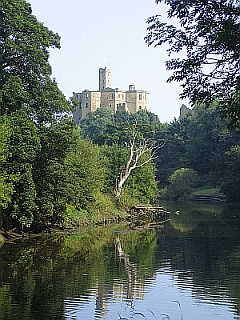 Warkworth Castle from the River Coquet
 © essentially-england.com
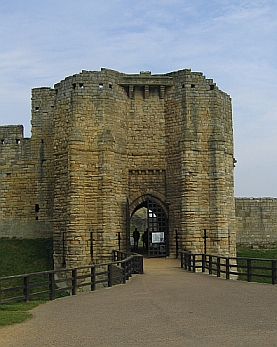 Warkworth Castle Gatehouse
 © essentially-england.com
A visit to Warkworth Castle would not be complete without an exploration of the village that lies so peacefully at the fortress' feet.
Georgian and Victorian houses cluster around the market square and the fortified medieval stone bridge - one of only a few left in the country - still leads traffic across the River Coquet.
But there are few places in Northumberland that have remained peaceful.
And Warkworth did not escape its share of horrors.
In 1174, the little Norman church of St Laurence was the scene of a terrible massacre, when the Scots Earl Duncan had all the villagers who had taken refuge there, put to the sword.
For more information about English Castles and some truly marvellous photos try out this guide by Adrian Pettifer.
For more information about Warkworth Castle, opening times, and events please follow this link to the English Heritage website.
Are You Planning to Visit Northumberland?
Where You Could Stay
There's a reason Northumberland is one of my favourite English counties. Its landscape is utterly gorgeous with long beaches and empty sweeps of hills that just beg to be walked. In between you can find small towns and pretty villages, conntected by lanes that are great on the bike as long as you have the legs for climbing. And there are holiday cottages to suit all tastes and budgets.

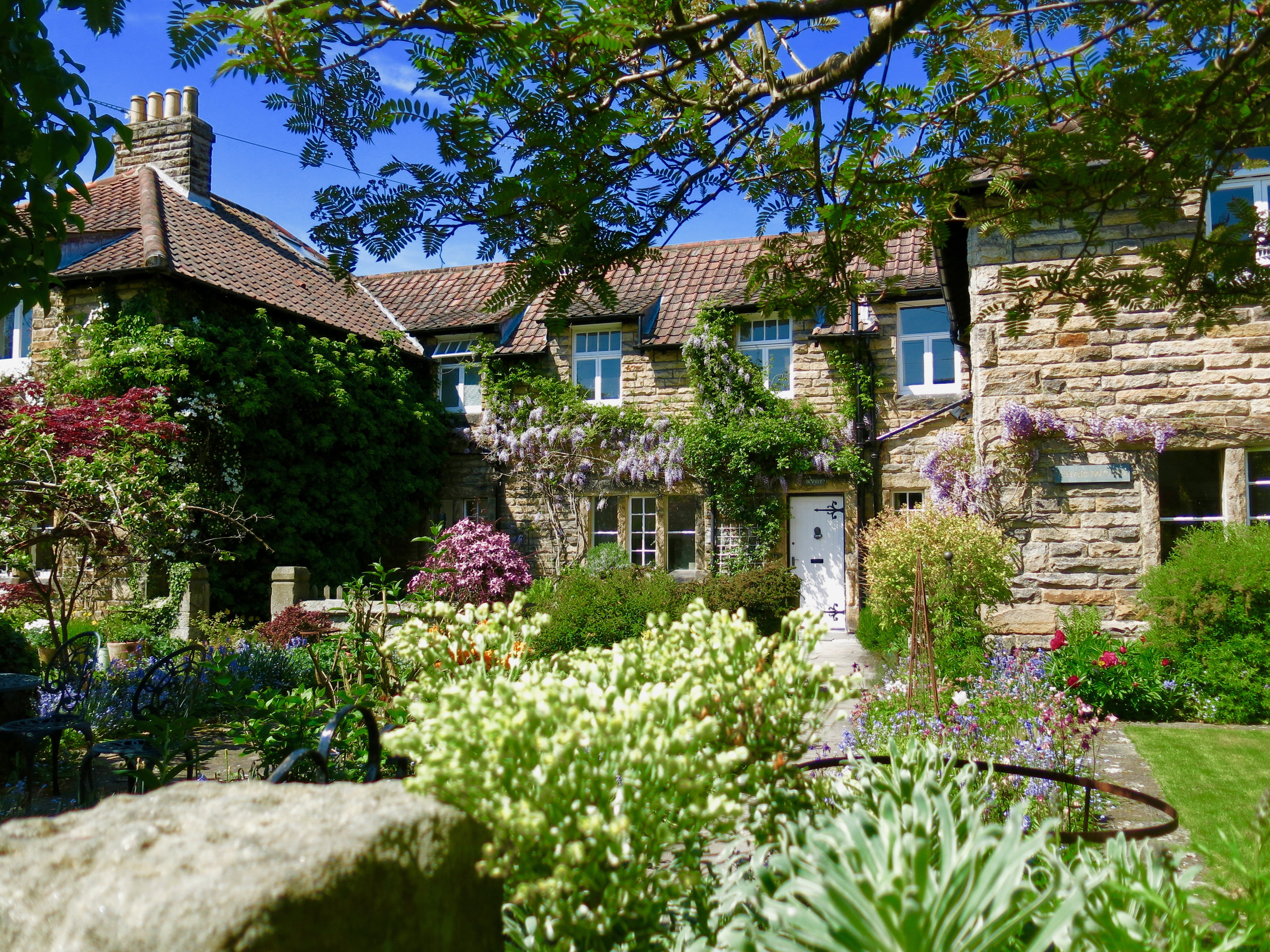

To see other holiday cottages in Northumberland click here. Or check out holiday cottages in other parts of England by clicking here.
Or you could try a family orientated Parkdean Resort in Northumberland.
If you need to find a hotel, then try one of these search platforms...
What You Could See and Do
Even if you stayed a month, you'd find that you don't have enough time to explore the county top to bottom and see everything it has to offer. There's plenty of history from Hadrian's Wall near Hexham to Lindisfarne in the north with reams of castles and ruins in between. There are beaches and seaside towns like Craster, Alnmouth and Seahouses - and some of the best fish & chips in all of England. There are market towns like Haltwhistle, Rothbury, Bellingham, Berwick, Warkworth and Harbottle to explore. And there are hillsides to climb and the great outdoors to enjoy.
Are you feeling in need of a holiday yet? Here are a few more pages that might give you ideas...
- Hadrian's Wall
- Berwick-upon-Tweed
- Alnwick Castle
- The Holy Island of Lindisfarne
- Take a stroll on the beach at Alnmouth
- Visit Alnwick with its famous castle and the cosy Barter Books bookshop
- Warkworth Castle
- Dunstanburgh Castle
- Cycling in Northumberland - my favourite tandem tour EVER!
- Spend the day exploring Cragside, near Rothbury, the worlds first home to have lighting powered by hydro-electricity
- Walk the St. Oswald's Way starting from Heavenfield and finishing at Lindisfarne
And if you want to explore more of Northumberland and its martial history, check out this Northumberland Castle Tour.
For more Northumberland Attractions return from the Warkworth Castle page to the Northumberland page.
Affiliate Disclosure: Essentially England uses affiliate links. This means that if you purchase something through a link on this site, we may earn a commission (at no extra cost to you).
Welcome to
Essentially England!
We're Steve & Sue, passionate about majestic castles, gorgeous stately homes, cosy pubs, and glorious roasts. Let us help you plan your perfect holiday, a brilliant day out, or simply transport you with a taste of tradition and a dash of history.